Single-breasted
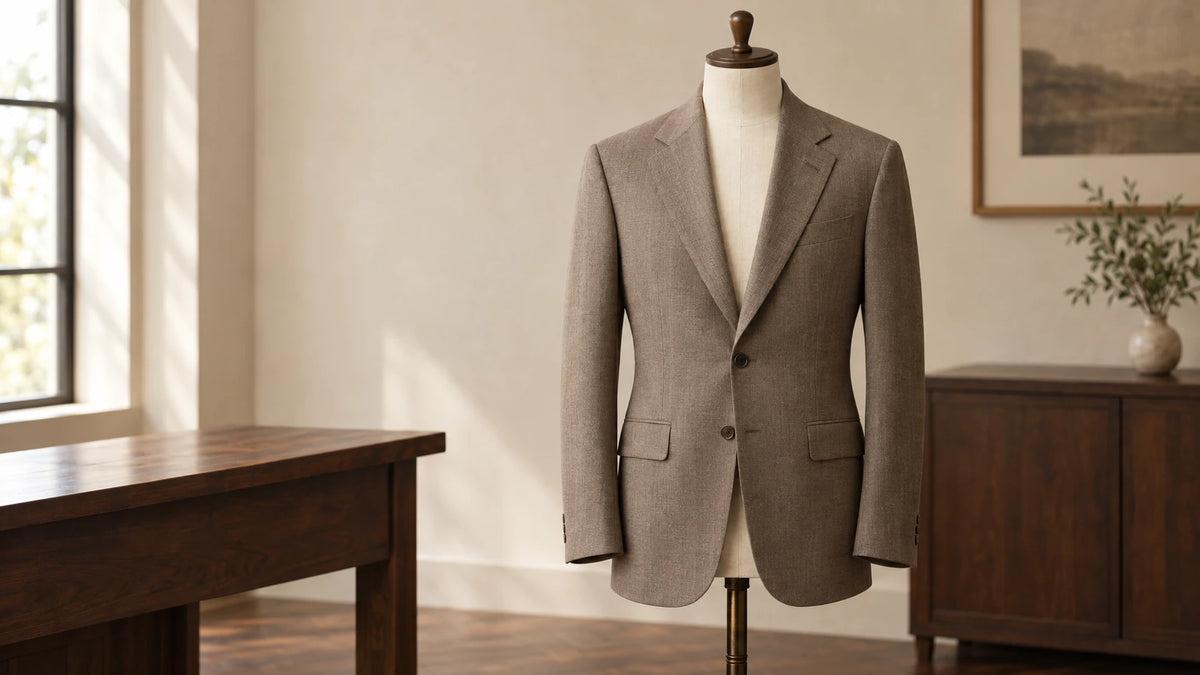
A single row of front buttons creates the jacket’s fastening line.
Our suggestion: begin here if you want a visually quieter front.
THE STYLE GUIDE / 01
Learn to see the garment as a whole. Then explore the details that shape its character, movement and finish.
An editorial illustration of tailoring details, not an exact configuration guide.
01
A single row of front buttons creates the jacket’s fastening line.
Our suggestion: begin here if you want a visually quieter front.
An overlapping front and two visible rows of buttons give the jacket a different structure.
Our suggestion: compare it when you want the jacket itself to make more of a statement.
Simplified front views, shown for comparison rather than as exact cutting patterns.
02
Vents are openings at the back of the jacket that help it move. A single vent sits at the centre; double vents sit to either side.
One central opening.
Two side openings.
No opening at the back.
Our approach: consider movement and the line you prefer, rather than judging a jacket from its vent alone.
03
A visible pocket sewn onto the outside of the jacket, with a more relaxed character.
A pocket opening covered by a flap of cloth.
A discreet slit opening, often used on formal evening jackets.
Illustrations isolate the pocket detail so the opening and construction are easy to compare.
Our recommendation: choose the pocket in the context of the cloth, lapel and occasion, rather than as an isolated detail.
04
The canvas is an internal structure between the outer cloth and lining. Full canvas extends through the front panels; half canvas supports the upper chest and lapels.
The middle layer is highlighted in brass. Ask your consultant which construction applies to the garment you are considering; construction is confirmed for the individual design.
The innermost layer is highlighted in brass. This is the visible inner layer of the garment, separate from the canvas beneath it.
Exploded layer studies: outer cloth, canvas and lining. Layers are separated here for clarity; they sit together in the finished garment.
TAKE THIS INTO YOUR CONSULTATION
Three useful preferences.
No measurements are collected in this guide. Your consultant will confirm the fitting next step.
KEEP THE CONVERSATION MOVING
Now, frame the silhouette.
Explore the next detail, or bring your questions to the consultant.

Your Suit. Your Rules.
Every garment starts with a conversation. We take your measurements, understand your lifestyle, and build something that's entirely yours — ready in 6 to 8 weeks.